 SurgePix Docs
How to Make a McKinsey-Style Deck with AI
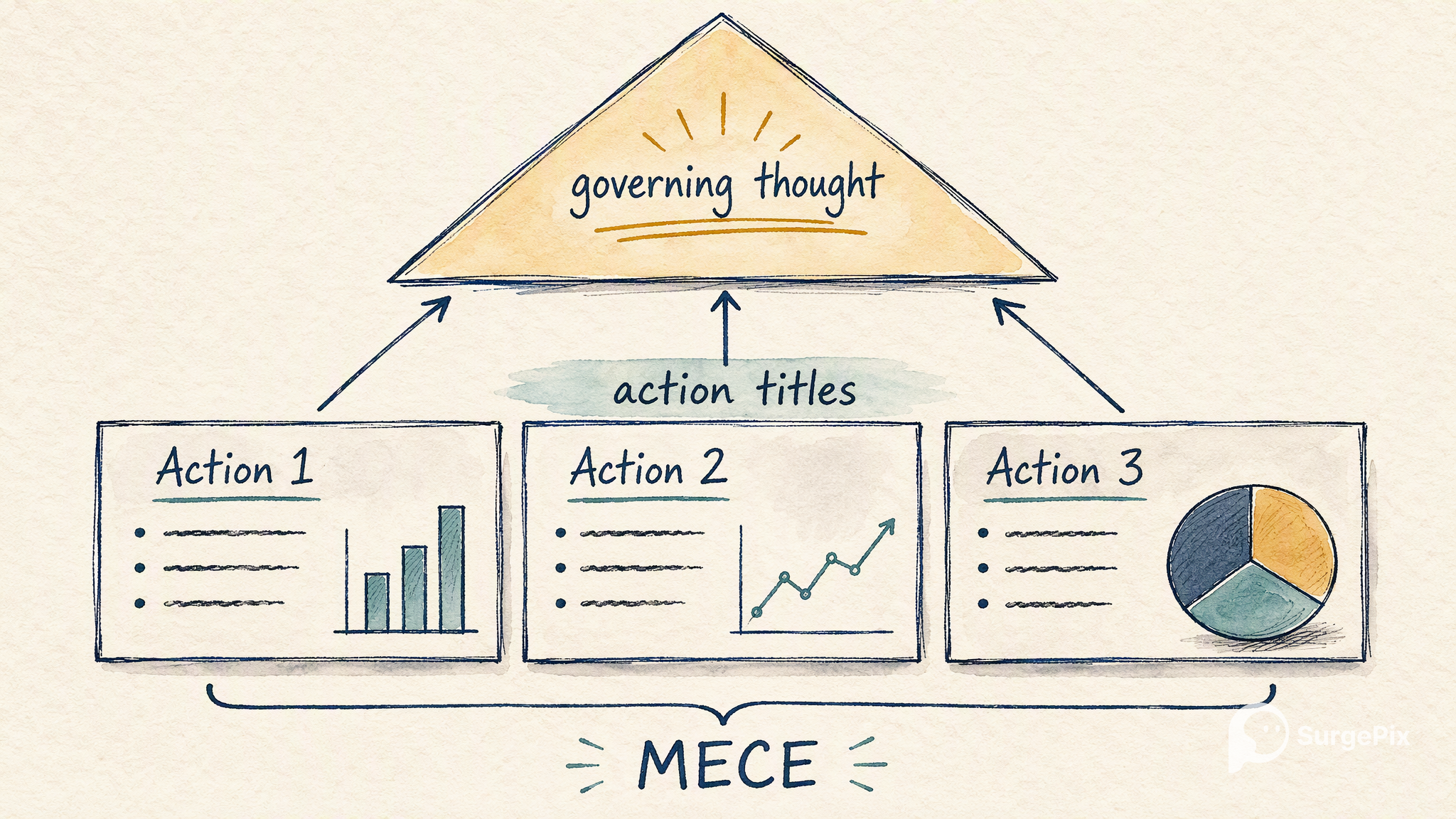
A "McKinsey-style" deck looks expensive because it follows a few strict rules — not because of fancy graphics. The good news: those rules are exactly the kind of structure AI is good at following. This guide breaks down what actually makes a deck consulting-grade, gives you the exact AI prompts to generate one, and shows how to refine it in SurgePix until it's boardroom-ready.
What makes a deck "McKinsey-style" (5 rules)
- Action titles, not topic titles. Every slide headline states the takeaway ("Enterprise, not SMB, drove 80% of new revenue") — not the subject ("Revenue"). Read only the titles top to bottom and you should get the whole argument.
- The pyramid principle. One governing thought up front, supported by MECE (mutually exclusive, collectively exhaustive) arguments beneath. Answer first, then support — never make the reader wait for the point.
- One message per slide. Each slide makes exactly one point, and the action title is that point.
- Evidence + "so what." Every claim is backed by a chart or number, and every chart states what it means.
- Restrained, consistent design. Limited palette, lots of white space, one chart per slide, no clutter. The thinking is the star, not the decoration.
How to build one with AI — step by step
1. The master prompt (generates the whole deck)
Create a 12-slide McKinsey-style strategy deck on [topic] for [audience]. Use the pyramid principle: slide 1 is an executive summary stating the single recommendation; then the governing thought; then 3 MECE supporting arguments, one slide each, each with one chart and a supporting data point; then implications, roadmap, risks, and next steps. Write ACTION TITLES — each slide title states the takeaway in a full sentence, not the topic. One message per slide, minimal text, restrained palette, one chart per argument, lots of white space.
2. Turn topic titles into action titles
Rewrite these slide titles as McKinsey-style action titles that state the takeaway as a full sentence a reader could act on: [paste your titles].
Before → after:
- "Market Overview" → "The market is doubling, but the winnable segment is SMB."
- "Q3 Results" → "Q3 beat plan by 12%, driven entirely by retention."
- "Competitors" → "Two incumbents own 70% — but neither serves our niche."
3. Structure the argument with the pyramid
Here's my rough content: [paste notes]. Organize it with the pyramid principle: state the single governing thought, then group everything else into 3 MECE supporting arguments. Flag anything that overlaps (not mutually exclusive) or any gap (not collectively exhaustive).
4. One chart per argument, takeaway in the title
For each supporting argument, recommend the single best chart type to prove it, and write the one-sentence takeaway that becomes the slide's action title.
A worked example (mini outline)
Topic: Should we enter the SMB market?
- Governing thought (slide 1): "Enter SMB now — it's the fastest-growing, least-defended segment, and our product already fits."
- Argument 1 — "SMB is growing 3x faster than enterprise." Chart: two-line growth comparison.
- Argument 2 — "Incumbents ignore SMB, leaving a $Xbn gap." Chart: market map / share by segment.
- Argument 3 — "Our product needs no rebuild to serve SMB." Chart: feature-fit matrix.
- Implications → roadmap → risks → the ask. Each with an action title.
Read just those titles and you already have the argument — that's the test of a McKinsey-style deck.
Generate, then edit every layer
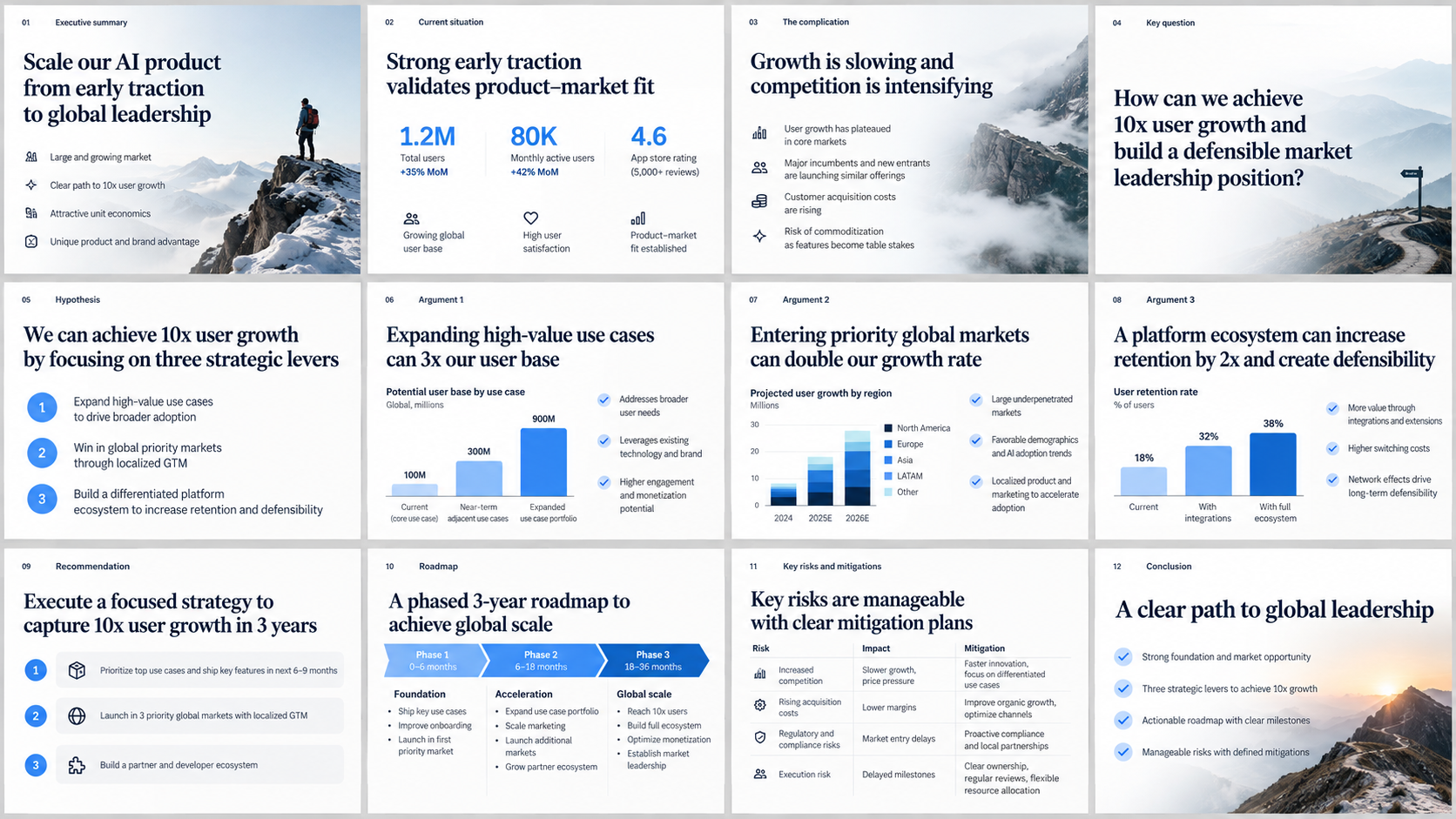
AI gives you a McKinsey-style structure in seconds — but the polish (tightening an action title, swapping a chart, aligning the palette across all 12 slides so it reads as one system) is editing, not re-generating. Most tools make you re-roll and hope. In SurgePix you generate the deck, then edit every layer until each action title lands and the whole thing looks boardroom-ready. Prompt for the structure; edit for the finish.
→ Try the master prompt in SurgePix (free daily credits).
Common mistakes
- Topic titles instead of action titles — the #1 tell of an amateur deck.
- Overlapping arguments — if two points bleed into each other, they're not MECE.
- Charts with no takeaway — a chart that doesn't state "so what" is decoration.
- Too much text — if a slide needs a paragraph, it's making more than one point.
FAQ
What is a McKinsey-style deck?
A presentation built on consulting conventions — action-title headlines, the pyramid principle, one message per slide, and evidence for every claim — so the argument is clear and skimmable.
What are action titles?
Slide headlines that state the takeaway as a full sentence ("Retention, not new sales, drove growth") instead of a topic ("Growth"). Reading the titles alone should tell the whole story.
What is the pyramid principle?
Barbara Minto's method: lead with the answer (governing thought), then support it with MECE arguments — mutually exclusive, collectively exhaustive.
Can AI really make a consulting-grade deck?
AI is excellent at the structure (pyramid, action titles, one-message slides). You still edit for judgment and polish — which is exactly the generate-then-edit loop SurgePix is built for.
How many slides?
- Most McKinsey-style decks run 10–14: executive summary, governing thought, 3–4 supporting arguments, implications, roadmap, risks, next steps.